The Doctor and the Devils is
one of several movies based on a true story; a
brilliant anatomist, Dr. Knox and two murderers, Burke and
Hare, during the years 1827-1828. The killers supplied
Knox with bodies he used in teaching students at an Edinburgh,
Scotland medical college. To mention some other movies
based on this story: the 1945 Val Lewton production
The Body Snatcher, the grim
Flesh and the Fiends (Mania)
from 1960, and Burke and Hare (1971.)
You will find many reasons why this
story has been re-told so often. First the memorable
characters. Dr. Rock (Knox) is a man with much arrogance; he
believes that he is right to defy outdated, hypocritical
laws. You can argue that he doesn’t know
where the two killers get their bodies–from people they’ve
just murdered. Or, that he does know, but
stubbornly refuses to deal with the question.
He is a complicated character. Many times
he is emotional—watch him when he lectures. At
other times he can be ice-cold. Yet you realize he
cares deeply about the poverty that overwhelms his city—far more
than most do in his privileged social class.
Fallon and Broome (Burke and Hare) are also
fascinating, completely lacking in conscience. The only
important question to them; can they get away with killing?
Right and wrong mean nothing.
The excellent screenplay by Ronald Harwood,
(adapted from an older work by the great poet Dylan Thomas)
changes the name of Dr. Knox to Dr. Rock, and Burke and Hare to
Fallon and Broom. Apart from that, it sticks closely to
the true story. (Remember that
The Body Snatcher was based on a short story—a work of fiction by Robert Louis Stevenson. It took
place years later, and had fictitious characters who had once
worked with Knox, Burke and Hare.)
Trying to compare the two movies is basically
apples vs. oranges. The Body Snatcher is
effective as a dignified historical drama, produced by a man
convinced that suggestion is scarier than what you actually
see. Forty years later,
The Doctor and The Devils had much more freedom
to sketch out the brutal, dead-end lifestyles of the Edinburgh
lower classes. The film-makers could show more violence,
brutality that reflected day to day reality.

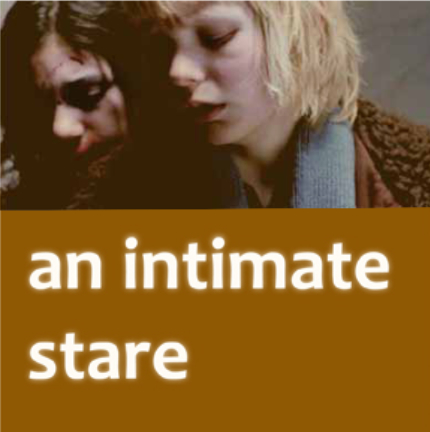
Jenny and Alice–a bleak existence; no reason to believe it
will change
You have to taste the ugliness to get
its full effect. Yet the movie is never uglier than it needs
to be.
Watch the scene where Fallon and Broom
find out Doctor Knox pays seven sovereigns for a fresh
corpse. For them, it’s an opportunity to make money they
could never get another way. This is serious
money. Never mind that all of it will be spent on gin,
whores and bets on cockfighting.

Dr. Rock examines a body Broom and Fallon have brought
him
For most of us, suggestion would not
be enough to show the lives of the 19th century urban
poor. Class divisions are like gaping canyons.
Dr. Rock’s assistant, Dr. Murray is in love with the
hooker Jennie. But Jennie is no dreamer, (“fine young
doctor’s lady I’d make…”) even though she realizes Murray
tells the truth about loving her.

Dr. Murray and Jenny
Dr. Rock must admit his share of the blame for
not dealing with an obvious situation. It is
unlikely that Broom and Fallon could have gotten their bodies
any other way but murder.
Yet, unlikely as it sounds, you still respect
Rock in living life true to his code. He spells out this
code clearly during his first lecture. First he
describes himself as a materialist, a man who does not believe
in the soul, because the soul has no shape. The heart
to him is not the seat of love, only an organ pumping blood.

Dr. Rock (Timothy Dalton)–A teacher his students
respect
Yet he also calls himself a man of sentiment,
and a moralist. He tells his student that doctors
must understand more than science; they must care as
well. As the story unfolds, you see that Rock puts his
money where his mouth is. At least twice in the movie, he
mentions the endless river of the Edinburgh poor, saying for
example, “They were men and women, once.”
He ends his opening words to his students as
follows: The science of anatomy contributes to
the great sum of all knowledge—The ends justify the
means. (His face in close-up.) You may not
be sure at first, but it becomes clear that Rock’s motivation
is not money nor his ego.
You don’t get as much of a look inside Broom
and Fallon, two men with no compassion whatever.
For Broom, it’s simply about the money. He is the one
who first realizes that murder makes more sense than
grave-robbing. He mentions this to Fallon, and Fallon is the
one who does most of the killing.
You get a few hints as to Fallon’s
motivation. He describes working as an orderly
during wartime. Fallon claims that the surgeon
encouraged (or ordered) him to kill many of the
mortally wounded and basket cases in the battle hospital.
I think Fallon is telling the truth
about his experiences. But he uses these experiences as a
way to rationalize, even to excuse, killing old or seriously
ill poor people.
As Broom learns, there is more to
Fallon; Fallon enjoys the killing even more than getting
money for it. Broom can feel the suspicions growing; a
trail of evidence starting to point at them. When
he tells Fallon, Fallon is already focused on two new
prospective victims, the whores Jennie and Alice.
“There’s a madness in you,” Broom says to Fallon.
Broom decides to testify against him; he
has no alternative if he wants to survive. Fallon is
convicted and hanged.
Ironically, a big reason that you sympathize
with Dr. Rock is his willingness, his willingness to learn from
his experiences.
He is arrogant and smug, but encounters with people
do change him. After he saves the simpleminded Billy
Bedlam’s life, he meets Billy’s sister Alice.
She wants to give Rock a ring to thank
him. She says she knows it is not worth much, but
“It’s of value to me.”
She walks away and Rock says, (without a trace
of sarcasm): “Aren’t people extraordinary?”
Other times, you see his arrogant side.
When someone brings up the subject of Broom and Fallon, Rock
snaps at them, “Do you expect the dead to
walk here? They need assistance.
Broom and Fallon provide that assistance.”
Yet later on, Rock learns first-hand that
these bodies too, are people. When Fallon
brings him his final body, Rock recognizes Alice.
You get a brief look at Dr. Rock’s
family. His sister Annabella is a pious but
shallow woman who feels disgraced by her brother’s opinions
and his life’s work. Annabella considers Rock’s wife worse
than a free spirit, more like a pornographer,
because of the anatomical drawings she sketches. Looking
back, Annabella sees her life wasted. She had no
chance to marry and only limited opportunities to
entertain. As a young woman she had expected far
more. Dr. Rock cannot accept her narrow-minded outlook but
does realize what she has missed in life.
Many critics felt the romance between Dr.
Murray and Jennie hurt the movie overall, that it felt out
of place, or unlikely or unnecessary. I can’t
completely disagree. But their relationship shows
you how deep class distinctions went in those years. It
is one thing to talk about the amount of money people have,
but what really hits home is the scene where Murray offers Jennie
money, simply to go and talk. He doesn’t realize that
this money equals a week’s wages for her.
Sadly, this movie did poorly at the box
office. Sadder still; it gives a glimpse of what its
director, Freddie Francis, could have done in the 60’s and
70’s if he had worked from better scripts. Francis
is remembered as an award-winning cinematographer, and as a
director of Hammer and Amicus films. But by the time
Francis began directing, Hammer’s best days were already behind
them. Probably no one could have made a good movie from
screenplays like
Dracula Has Risen From the Grave,. and many more on that
level.The Doctor and the Devils was one of the few
excellent scripts that Francis got to film, probably the
only one. He made the most of it.